Best Trivia Apps for Events: A 2026 Comparative Review
An honest side-by-side look at Kahoot, Quizizz, Mentimeter, Jackbox, Slido, and BuzzerBug — covering real weaknesses as well as strengths, with a decision flowchart to pick the right tool for your event.
2026-03-21 · 11 min read · BuzzerBug™ Team
The State of the Market
The market for digital quiz and trivia tools has fragmented significantly since 2020. What was once a simple choice — Kahoot for classrooms, nothing for everywhere else — is now a populated field with distinct products serving distinct needs. The danger of this proliferation is choosing the wrong tool for your context and discovering the mismatch only once you are standing in front of a room full of impatient players.
This review evaluates six tools across six dimensions: ease of entry (how quickly can a new player join?), competitive mechanic (is there a genuine first-to-answer system?), TV or shared display support, latency fairness, offline capability, and total cost.
Kahoot
Best for: School classrooms, large corporate training, conferences where everyone is already on a device.
Kahoot is the category-defining product for synchronous digital quizzes. Its game PIN system is fast and familiar — teachers have been using it since 2013, meaning many adult participants already know the interface without instruction. Its question editor is comprehensive: multiple choice, true/false, polls, open-ended, puzzle sequences.
Genuine strengths: Kahoot scales to thousands of simultaneous players without meaningful degradation. Its classroom reporting suite gives teachers per-student data across multiple sessions. The free tier is genuinely usable for basic events.
Genuine weaknesses: Kahoot is not a buzzer system. Questions are time-limited multiple choice; there is no mechanism for a player to "buzz in" first and earn the right to answer before others can respond. This is a fundamental design difference from live trivia events where the first correct answer wins. Additionally, Kahoot requires app installation on mobile devices — the browser version exists but is deliberately less smooth than the app to encourage downloads. In a pub setting where twenty people need to join in under two minutes, the installation friction is a serious problem.
Cost: Free for basic use; paid tiers starting at approximately $17/month for advanced features. Schools often have institutional licences.
BuzzerBug
Best for: Live trivia nights (pub quiz, corporate events, classrooms), any context where first-to-answer precision matters.
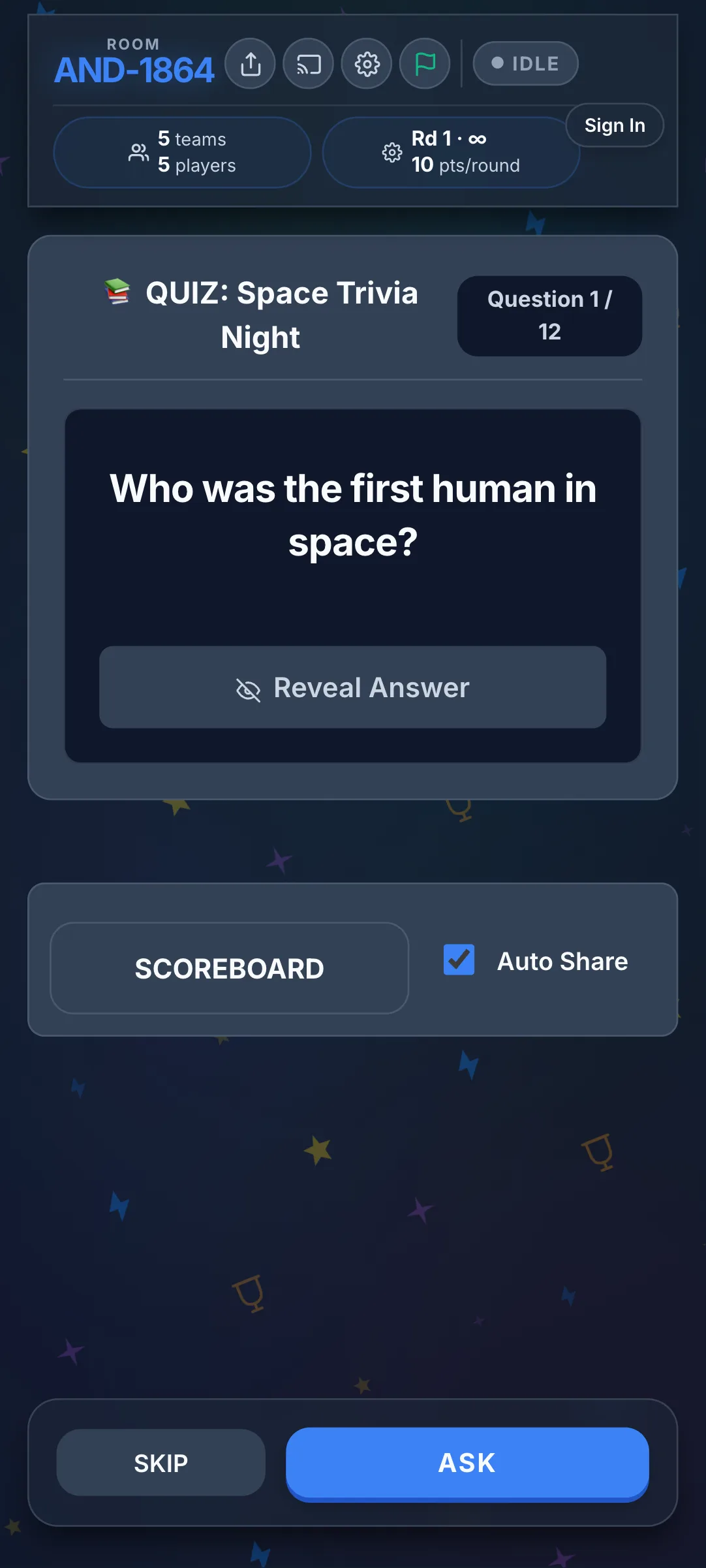
BuzzerBug is purpose-built for one specific mechanic: accurately identifying which player buzzed in first. Everything else in the product is designed to support that core function.
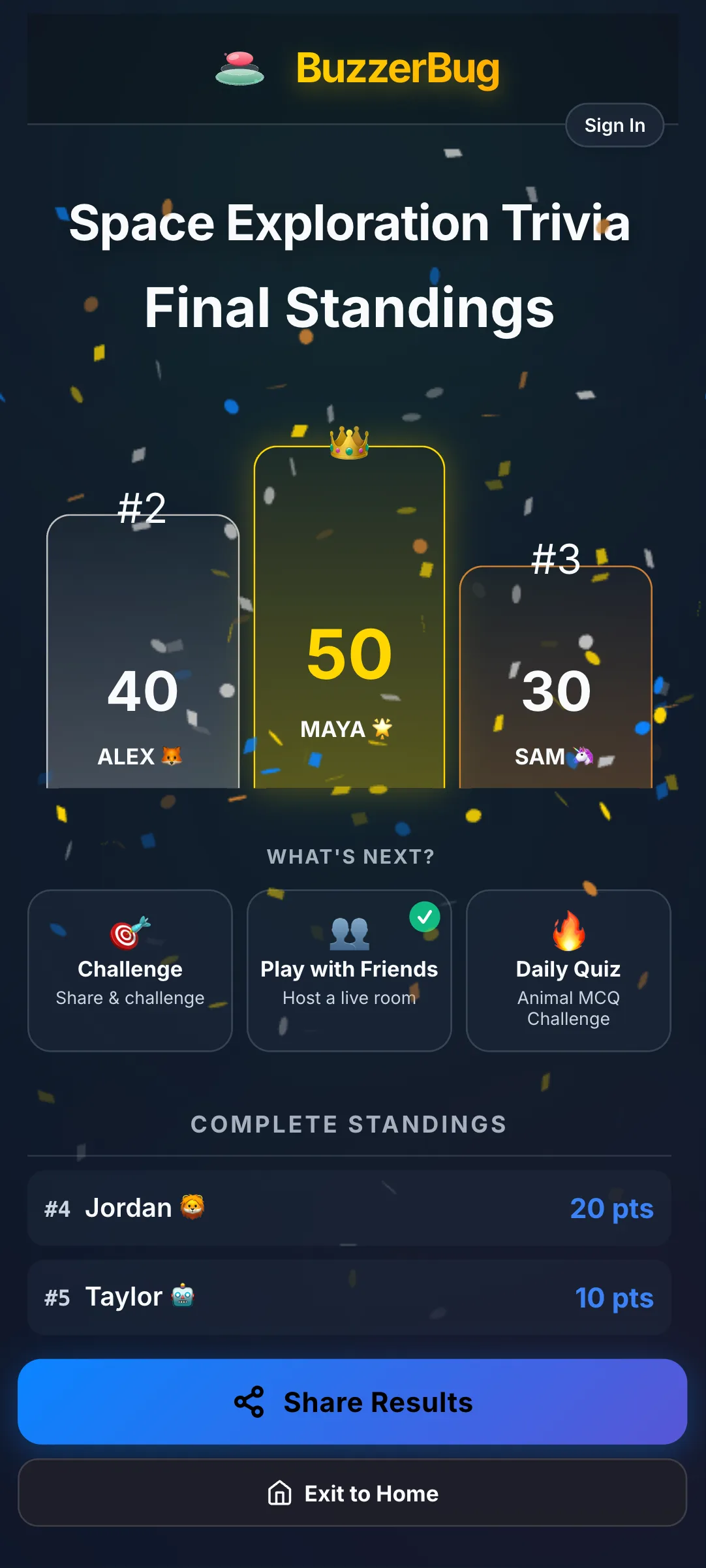
Genuine strengths: Zero download required — participants join via a URL or QR code in their phone's browser, and they are ready to buzz within ten seconds. WebSocket connections ensure that the first tap is captured with sub-100ms precision regardless of the number of concurrent players. The TV view mode displays the room code, question prompt, and real-time leaderboard on any screen connected to the host's device via HDMI or casting. The host panel and participant buzzer are on separate interfaces, so the host never accidentally buzzes. Daily Drop mode provides a pre-built daily trivia format for recurring use.
Genuine weaknesses: As a newer platform, BuzzerBug does not yet have the third-party integrations (LMS plugins, Webex, Slack) that established tools have built over years. The question library is growing but smaller than Kahoot's. Reporting and analytics features are simpler than what a classroom teacher accustomed to Quizizz's per-student dashboards might expect.
Cost: Most functionality is Free; Premium only needed for generating AI quizes.
Quizizz
Best for: Homework assignments, asynchronous self-paced quizzes, blended learning classrooms.
Quizizz's defining differentiator is its asynchronous mode: students can complete a quiz at their own pace, on their own schedule, and the teacher sees results in aggregate. This is genuinely powerful for homework-based formative assessment.
Genuine strengths: The self-paced mode is Quizizz's irreplaceable feature. Meme-based feedback (customisable reaction images for correct and wrong answers) makes it genuinely engaging for younger students in a way that more clinical interfaces do not. Detailed analytics per question per student.
Genuine weaknesses: Quizizz is explicitly not designed for live event hosting. Its "live" mode still operates on a time-per-question model rather than a buzzer model. In a pub or corporate event context, it requires app installation and a teacher or host account. The interface is visually busy in a way that can feel overwhelming on a TV display.
Cost: Free for basic use; paid tiers starting at approximately $20/month for premium features.
Mentimeter
Best for: Corporate workshops, conference keynotes, audience polling, word clouds.
Mentimeter is not really a trivia tool at all — it is an audience interaction tool that happens to include a quiz mode. Its strongest features are word clouds, scales, ranking questions, and open text polls.
Genuine strengths: Mentimeter's word cloud feature is unmatched for live audience visualisation. No other tool in this list produces the same collective "oh, interesting" response when you display what three hundred people typed in response to "describe this year in one word." For presenters who want interaction without competition, Mentimeter is excellent.
Genuine weaknesses: There is no competitive mechanic. No leaderboard, no first-to-answer, no buzzer. The quiz mode shows scores but does not award points based on speed. For anyone hosting a genuinely competitive game, Mentimeter is the wrong tool. It also requires login for hosts and has limited free tier event sizes.
Cost: Free for basic events up to approximately 50 participants; paid tiers starting around $11.99/month.
Jackbox Games
Best for: Small group parties (4–10 people), living room gaming, friend groups who already know each other.
Jackbox produces party game packs rather than a quiz platform. Its most relevant titles for trivia contexts are Trivia Murder Party and Quiplash. The games are rich, well-designed, and genuinely funny.
Genuine strengths: Jackbox games have production quality that no quiz platform matches — custom animations, voice acting, multi-stage game flows. For a tight group of friends or a small office party, they create a polished experience. No account creation required for participants; they join via a room code on jackbox.tv.
Genuine weaknesses: Jackbox requires a host device running a game pack purchased from a digital storefront (Steam, PlayStation Store, etc.), which costs $25 to $40 per pack. There is no buzzer mechanic — questions are answered simultaneously, not competitively in real time. Maximum player count is typically eight to ten before the experience degrades. Completely unsuitable for events over twenty people.
Cost: One-time purchase of $25–$40 per game pack; no subscription.
Slido
Best for: Enterprise conferences, large meetings, Q&A sessions with leadership.
Slido was acquired by Cisco in 2021 and is now deeply integrated with Webex. Its primary use case is audience Q&A, live polling, and word clouds at enterprise events.
Genuine strengths: Slido handles extremely large audiences (tens of thousands) with reliable uptime. Its integration with presentation software (PowerPoint, Google Slides) is seamless. Moderated Q&A mode — where submitted questions are curated before going live — is genuinely valuable for controlled corporate environments.
Genuine weaknesses: No game mechanic. No competition. No buzzer. No leaderboard. Slido is a polling and Q&A tool and should be evaluated only as such. Its quiz mode assigns points but does not rank on speed. Pricing at enterprise scale is significant and non-transparent.
Cost: Free for basic use with up to 50 participants per event; paid plans required for larger events or advanced features.
How to Choose: A Decision Flowchart
- Do you need asynchronous (homework) mode? → Quizizz
- Do you need word clouds or text polling rather than competition? → Mentimeter for interaction, Slido for enterprise Q&A
- Is your group 4–8 people at home or in a living room? → Jackbox
- Is your primary context a school classroom with an institutional account? → Kahoot (if you already have it), BuzzerBug (if you need buzzer mechanics)
- Are you hosting a live competitive event — pub quiz, corporate game show, classroom buzzer round — where first-to-answer is the central mechanic? → BuzzerBug
- Do participants need to install an app? → Eliminate Kahoot and Quizizz for casual pub/event contexts; both BuzzerBug and Jackbox.tv require no installation
The clearest summary: Kahoot is the best tool for what it was designed to do (synchronous classroom quizzes at scale). BuzzerBug is the best tool for what it was designed to do (live competitive buzzer events). They are not competing for the same use case despite appearing similar.
Ready to Play?
Create a free game room in seconds. No download, no account needed for players.
Start a Free Quiz Game