How to Host the Perfect Pub Trivia Night with Digital Buzzers
Everything a first-time (or veteran) host needs: venue setup, round formats, crowd management, question writing across difficulty tiers, and how a real-time TV view changes the atmosphere in the room.
2026-09-10 · 10 min read · BuzzerBug Editorial Team
Before You Even Book the Venue
The single biggest mistake new trivia hosts make is treating the event as an afterthought — booking a back room, printing some questions, and hoping for the best. Great trivia nights are engineered experiences. They have a rhythm, a personality, and a host who understands crowd psychology as well as general knowledge.
Start with one non-negotiable question: why should someone leave their sofa for this? The answer shapes every decision that follows, from the round structure to the marketing copy.
Choosing the Right Venue Setup
Look for a room where you can control noise. Open-plan bars are difficult because you're competing with background music, kitchen clatter, and conversations at adjacent tables. A side room or defined section with a door is ideal. Failing that, negotiate with management to lower background music during play.
The physical layout matters more than most hosts realise. Rows of chairs facing a screen create a classroom feeling — not the atmosphere you want. Round tables of four to six people encourage team discussion and mimic the pub quiz energy audiences expect. Ensure every seat has a clear sightline to the display screen.
For your equipment, you need far less than you think:
- A laptop or tablet for the host interface
- An HDMI cable or wireless casting dongle to connect to the venue's TV or projector
- A stable Wi-Fi connection (or a personal hotspot as backup)
- Optionally, a Bluetooth speaker if the room's acoustics are poor
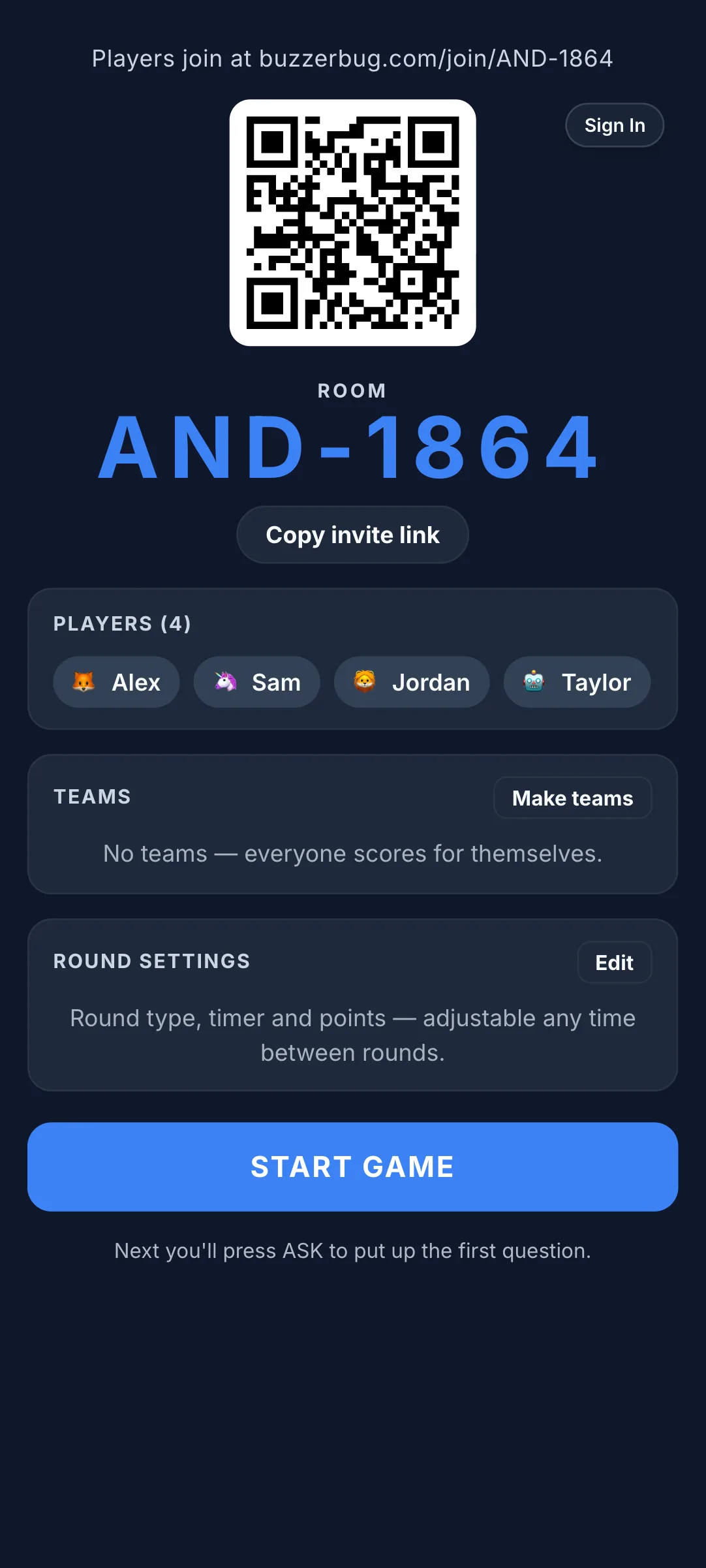
That is genuinely the entire hardware list. Every player uses their own smartphone as a buzzer, which means no renting, no shipping, no broken buttons.
The Five Core Round Types
A well-structured night uses variety to maintain energy. Here is a proven five-round structure for a two-hour event:
| Round | Format | Why it works |
|---|---|---|
| 1 · Warm-up | General knowledge, moderate | Settles nerves, gets teams talking |
| 2 · Picture | Images on the shared TV view | Everyone sees the same screen — no "couldn't read it" |
| 3 · Specialist | One deep-dive topic, pre-announced | Free marketing; regulars come prepared |
| 4 · Speed | First-to-buzz, wrong answers lose a point | Flips the room's energy and rattles the leaders |
| 5 · Wager | Teams bet points on one final question | Anyone can win right up to the last answer |
Round 1 — General Knowledge (Warmup): Ten questions of moderate difficulty. The goal is not to stump anyone immediately; it is to settle nerves, get teams talking, and establish the host's voice. Mix topics: geography, history, sport, entertainment.
Round 2 — Picture Round: Display ten images on the TV view. Pub quiz classics include: identify the celebrity from a childhood photo, name the film from a screenshot, identify the logo with the brand name removed. This round works brilliantly with BuzzerBug's TV mode because every table sees the image simultaneously on the shared screen, eliminating the "I couldn't see the print" complaints of paper rounds.
Round 3 — Specialist Category: Pick one deep-dive topic and advertise it in advance on social media. "This week's specialist round: 1990s video games." Regulars will research it. New teams feel included if they happen to know it. The pre-announcement also drives event marketing almost for free.
Round 4 — Speed Round: First to buzz wins the point. Wrong answers deduct a point. This round changes the energy of the room dramatically — suddenly quiet teams become aggressive, and dominant teams can fall apart under pressure. Keep questions short and unambiguous. "Name the capital of France" is perfect. "Name the third largest city in France by metropolitan area" is not.
Round 5 — Wager Round: Before the final question is revealed, every team writes down how many of their accumulated points they want to wager. Reveal a single high-stakes question. Teams can wager zero to their full score. This mechanic produces genuine drama: a team twenty points behind can leapfrog the leaders in a single answer. The TV view leaderboard showing the final result in real time is worth the entire evening.
Writing Questions Across Difficulty Tiers
Balance is the craft of question writing. Aim for roughly 40% easy (most teams should get this), 40% medium (about half the room), and 20% hard (only one or two tables). If your hard questions are unanswerable, you've written trivia for yourself, not your audience.
"The best trivia question teaches you something even when you get it wrong." — This is the north star for every question you write.
Avoid questions with multiple legitimate answers ("Name a country beginning with A" has seven). Avoid questions that depend on outdated information unless you specify the year. Avoid obscure sports statistics unless your audience has self-selected for that.
Good question construction: state the category, give any clarifying context, ask a single specific thing. Bad: "Who played James Bond?" Good: "Which Scottish actor was the first to play James Bond on film?"
Managing Crowd Dynamics
Teams that are losing interest are your biggest operational problem. Watch for the table that stops writing answers around round three — they've mentally checked out. The solution is to keep the leaderboard visible at all times. Even a team in last place stays engaged if they can see a path back in via the wager round.
Handle cheating diplomatically. A public accusation destroys the atmosphere. Instead, build in structural disincentives: randomise question order slightly between rounds, use the buzzer for tiebreakers so phone lookups are too slow to help, and make it clear in your opening remarks that you reserve the right to ask any team to show their working.
Common Hosting Mistakes
- Reading questions too fast. Slow down by 30% from what feels natural. The room is noisier than your rehearsal space.
- No buffer between rounds. Use two minutes of music or a "fun fact" slide between rounds. Teams need to finish writing, visit the bar, and reset.
- Skipping the answer reveal explanation. When you reveal an answer, tell the story behind it. That thirty-second context transforms a fact into a memory.
- Inconsistent timing. Start at the same time every week. Regulars plan their evening around you.
Tips for Recurring Nights
Your first night will be rough. Your fifth will feel natural. Your twentieth will have a waiting list.
Build consistency into everything: same night, same host name or persona, same rough structure. Introduce one new format per month to keep regulars surprised. Keep a question database and tag questions you've already used — repeating a question within six months to the same audience is an unforgivable sin.
Consider a season structure: eight weeks of regular nights, a grand final with the top teams competing for a trophy or bar tab, then a two-week break. The season structure gives regulars a reason to attend every week rather than dipping in occasionally.
Ready to Play?
Create a free game room in seconds. No download, no account needed for players.
Start a Free Quiz Game