Pop Quizzes, Permanent Memories
Pop Quizzes, Permanent Memories: Why Testing is Your Brain’s Ultimate Workout
2026-06-10 · 3 · BuzzerBug™ Team
Pop Quizzes, Permanent Memories: Why Testing is Your Brain’s Ultimate Workout
Most of us grew up believing that the best way to learn something is to pour over it repeatedly—highlighting text, re-reading chapters, and staring at diagrams until they are burned into our retinas.
But cognitive psychologists have known for decades that this passive approach is actually an illusion. If you want a memory to truly stick, you shouldn't be trying to force information in; you need to practice pulling it out.
This is the power of the testing effect (or retrieval practice), and it is the primary reason why quizzes are one of the most effective tools for improving long-term memory function.
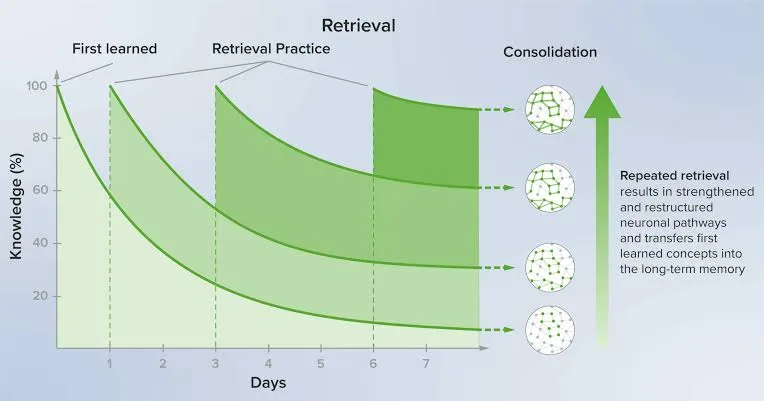
The Impact of Retrieval Practice on Memory Retention. Source: Lecturio
As shown in the graph above, every time you actively retrieve a memory during a quiz, you interrupt the brain's natural "forgetting curve." Rather than just testing what you know, the act of retrieval alters the memory trace itself, shifting it from a fragile, temporary state into a consolidated, long-term format by strengthening your neural pathways.
How Quizzing Rewires Your Brain
When you sit down and take a quiz, your brain undergoes a series of distinct cognitive and neurobiological shifts that passive reading simply cannot replicate.
1. The "Backward Effect" and Memory Consolidation
In cognitive psychology, the direct benefit of testing is often called the backward effect. When you try to answer a quiz question, your brain has to search through its semantic network to locate the correct piece of data.
This effortful retrieval acts as a mental workout. It signals to the hippocampus (the brain's memory hub) that this specific information is highly critical for survival, triggering a process called reconsolidation. Each time a memory is retrieved and reconsolidated, the neural pathways connecting to it become thicker and more durable.
2. Activating the Brain’s Reward Network
Quizzing introduces an element of curiosity and problem-solving that text-heavy studying lacks. Neuroimaging studies show that when you confront a quiz or trivia question, the knowledge gap activates your brain's reward network (specifically the midbrain and ventral striatum).
This activation releases a quick surge of dopamine into the hippocampal memory system. When you finally reveal the correct answer, that dopamine spike essentially acts like a "save button," cementing the correct information into your brain far more effectively.
3. Curing the "Illusion of Competence"
Have you ever read a page in a book, closed it, and realized you have no idea what you just read? That is the illusion of competence. Because the text looks familiar while your eyes pass over it, your brain tricks you into thinking you've mastered it.
Quizzing provides immediate, brutal honesty. It forces metacognitive calibration—helping you accurately monitor what you actually know versus what you think you know. It highlights your knowledge gaps so you can target your energy exactly where it is needed.
Comparing the Strategies
To see how quizzing stacks up against other common study habits, cognitive scientists look at effort levels and long-term retention rates. A breakdown of the data reveals stark differences:
| Study Strategy | Cognitive Effort | Metacognitive Benefit | Retention After 1 Week |
| Passive Re-reading | Low | Very Low (Creates false confidence) | Poor (Rapid forgetting) |
| Flashcards (Recognition) | Moderate | Medium (Tests if you look at the back) | Moderate |
| Active Quizzing (Free Recall) | High | High (Exposes exact knowledge gaps) | High (Up to 135% improvement) |
In a classic study by Butler & Roediger, students who took short-answer quizzes on lecture material retained 31% more information than those who restudied summaries, and a staggering 135% more than those who did not review the material at all.
The Best Way to Use Quizzes
To get the most out of this effect, quizzes shouldn't just be a final exam at the end of a semester. The best results happen when quizzing is low-stakes (done frequently for practice rather than grades) and spaced out over days or weeks.
Additionally, always ensure you use quizzes that provide immediate feedback. If you answer a question incorrectly on a quiz and don't check the right answer, you risk accidentally consolidating the wrong information. Pair the struggle of active recall with immediate correction, and your memory function will skyrocket.
References
Gruber, M. J., Gelman, B. D., & Ranganath, C. (2014). States of Curiosity Modulate Hippocampus-Dependent Learning via the Dopaminergic Circuit. Neuron, 84(2), 486-496. https://doi.org/10.1016/j.neuron.2014.08.060
Cited by: 1235
Roediger, H. L., & Butler, A. C. (2011). The critical role of retrieval practice in long-term retention. Trends in Cognitive Sciences, 15(1), 20-27. https://doi.org/10.1016/j.tics.2010.09.003
Cited by: 2813
Roediger, H. L., & Karpicke, J. D. (2006). The Power of Testing Memory: Basic Research and Implications for Educational Practice. Perspectives on Psychological Science, 1(3), 181-210. https://doi.org/10.1111/j.1745-6916.2006.00012.x
Cited by: 3289
Ready to Play?
Create a free game room in seconds. No download, no account needed for players.
Start a Free Quiz Game