How to Host a Friends Game Night Where Everyone Can Actually Play: The Power of Estimation Trivia
Tired of trivia nights where one expert dominates while everyone else waits for the game to end? Discover how AI-hosted estimation trivia, tactile slider rounds, and custom topics level the playing field—turning competitive tension into pure shared laughter.
2026-09-05 · 9 min read · BuzzerBug Editorial Team
The Living Room Game Night Paradox
Picture a familiar scene: five or six close friends gather in a living room on a Friday evening. Drinks are poured, food is ordered, and someone suggests playing trivia.
Instinctively, everyone likes the concept of a quiz. We love friendly competition, sharing laughs, and testing our intuition. Yet within fifteen minutes, the energy in the room often deflates into awkward silence. Two people are furiously arguing over whether a specific historical treaty happened in 1783 or 1784; the host is hunched over a laptop frantically managing score sheets and stopwatch timers; and the rest of the couch has pulled out their phones, politely waiting for the game to wrap up so the evening can move on.
Why does an activity meant to unite friends so frequently end up dividing them?
The truth is that traditional trivia suffers from two fundamental design flaws: the Quizmaster Sacrifice and the Fact-Recollection Trap.
Fortunately, modern game design and digital buzzer technology have solved both. By replacing manual hosting with automated AI orchestration and swapping strict fact recall for numerical estimation (slider) quizzes, you can host a game night where 100% of your friends play together, nobody feels alienated, and the entire room is locked in shared laughter from the first question to the final podium.
1. The "Quizmaster Sacrifice": Why Traditional Hosting Ruins the Group Vibe
Whenever a group of friends attempts to run a DIY trivia night, the first logistical hurdle is immediate: who is going to host?
In analog trivia or traditional quiz apps, being the host is a full-time, high-friction job:
- Preparation Burnout: Someone has to spend hours researching questions, vetting answers, or buying pre-made question card packs.
- The Player Penalty: Because the host knows all the questions and answers in advance, they are completely barred from playing. In a tight circle of five or six friends, sacrificing one person to act as the administrative referee instantly shrinks the game and breaks the social symmetry of the night.
- The Friction of Administration: The host has to be the clock-watcher, the scorekeeper, and the arbiter of disputes. Instead of relaxing with a drink and laughing along with their friends, they are managing timers, reading slides, and scribbling tally marks on a notepad.
- The Rotation Dilemma: Some groups attempt to solve this by rotating hosts each round. In practice, this merely passes the penalty around the room: every 10 minutes, another friend is benched, disrupting the momentum and turning the flow of the night into stop-and-start administration.
The BuzzerBug Fix: The Zero-Host Automated Game Show
BuzzerBug eliminates the Quizmaster Sacrifice entirely through automated AI and bot hosting.
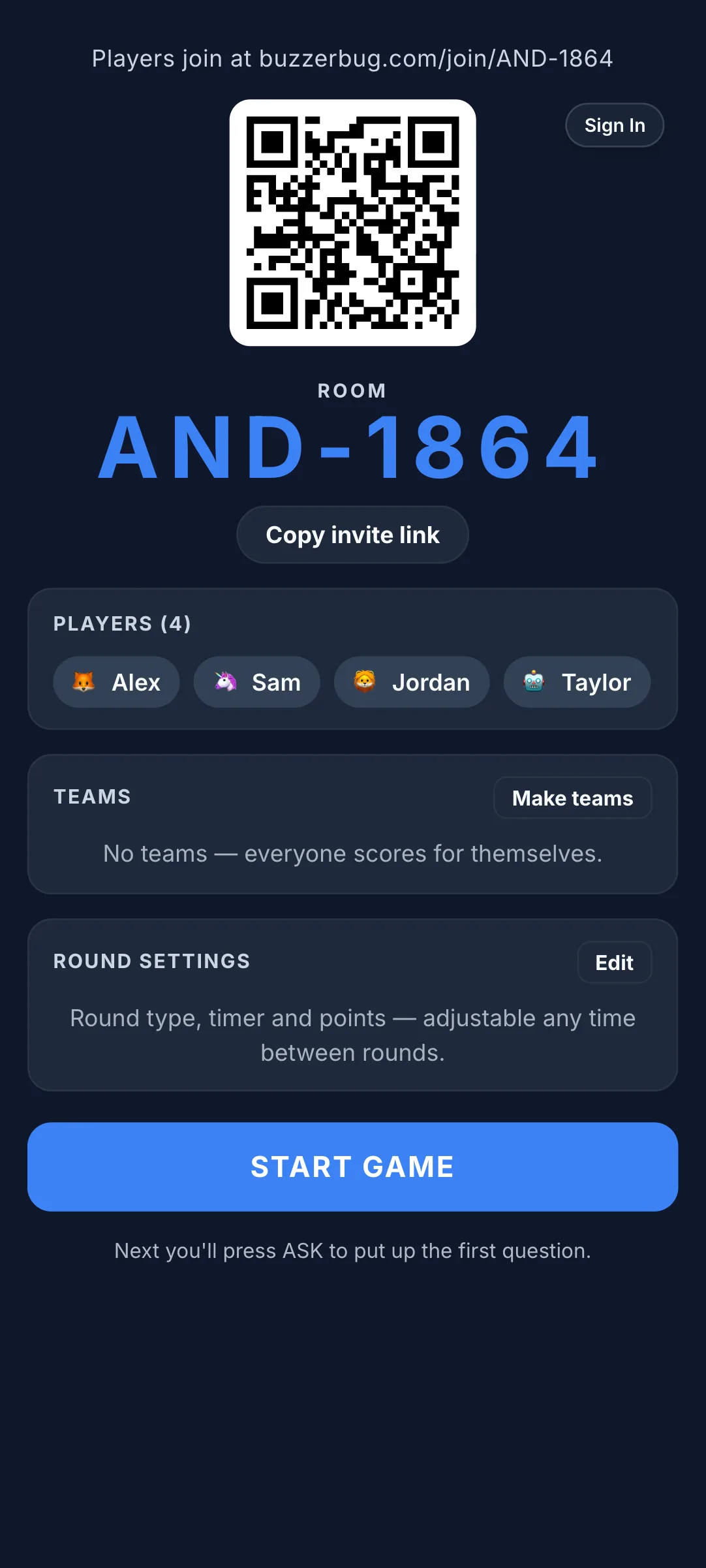
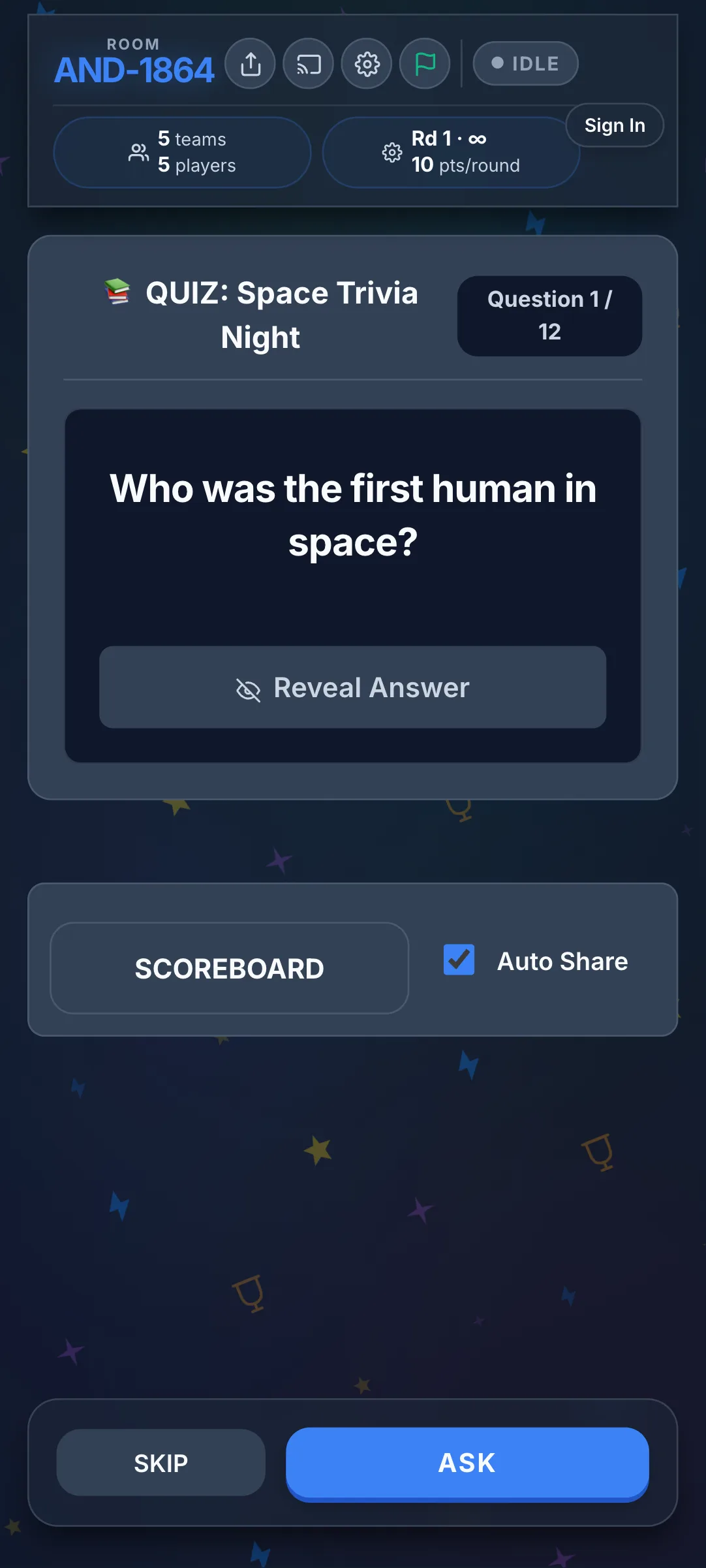
When you launch a session on BuzzerBug:
- The Shared TV View (
/tv/:roomCode): Put the dedicated spectator display up on your living room Smart TV, projector, or laptop screen. The TV display acts as the room's central game-show anchor, automatically presenting the question, ticking down high-visibility timers, and rendering animated leaderboards. - Instant QR Code Onboarding: Friends point their phone cameras at the QR code on the TV screen (or visit buzzerbug.com/join and enter the 4-letter room code). There are no app store downloads, no password registrations, and zero account signups. An entire group of friends connects in under 30 seconds.
- Automated Pacing & Scoring: When set to automated pacing (or Bot Host mode), BuzzerBug handles the countdowns, adjudicates buzzer lock-outs, calculates points, and orchestrates podium reveals automatically.
The result? The person who initiated the game sits on the couch, holds their phone, and plays right alongside everyone else. Nobody is sidelined. 100% of the friends in the room participate as equal contenders.
2. The "Trivia Trap": The Fact-Recollection Problem
Even when the logistical hurdle of hosting is solved, traditional trivia frequently crashes into a second, deeper barrier: the nature of fact recollection.
Traditional trivia is almost universally built on binary recall:
- "What is the capital of Kazakhstan?"
- "In what year was the Treaty of Ghent signed?"
- "Who directed the 1973 film The Sting?"
For these questions, human memory operates in black and white: you either know the exact datum, or you do not. There is rarely any middle ground.
How Binary Recall Divides the Room
When binary fact recall governs the game night, a predictable and damaging group dynamic unfolds:
- The Specialist Monopoly: Every social circle has one or two friends with encyclopedic memories or niche trivia backgrounds. They jump to the top of the leaderboard within three questions and build an insurmountable lead.
- The "Wait for It to End" Spiral: Friends who do not possess encyclopedic knowledge quickly realize they have zero mathematical chance of catching up. When you are sitting in 5th place with 200 points while 1st place has 1,800 points, guessing ceases to be fun.
- Intellectual Vulnerability: Nobody likes feeling uneducated or slow in front of their peer group. Strict fact quizzes can accidentally trigger performance anxiety, making casual players feel defensive or checked out.
- The Post-Game Slump: Instead of active conversation, half the room quietly retreats into their personal smartphones, disengaging from the gathering and waiting for the quiz to end.
A game night is supposed to be a social catalyst, not a high school pop quiz. If a mechanic leaves the majority of players feeling excluded, the problem is not the players—it is the game mechanic.
3. Why Estimation (Slider) Quizzes Are the Ultimate Equalizer
To keep every single friend engaged, you need a mechanic where everyone can participate, everyone has a valid instinct, and nobody feels foolish for guessing.
This is precisely where Estimation Quizzes (Slider Rounds) change the entire atmosphere of the room.
How BuzzerBug Estimation Trivia Works
Rather than testing whether someone remembers an obscure name or date, estimation questions pose numerical and scale-based puzzles about the physical world, pop culture, bizarre records, and surprising statistics:
- "How many hot dogs did Joey Chestnut consume in 10 minutes to set the world record?"
- "What is the average flight speed of a worker honeybee in miles per hour?"
- "How many total feet tall is the statue of Christ the Redeemer in Rio de Janeiro?"
- "How many thousands of miles of blood vessels run through the human body?"
Instead of picking from four multiple-choice options or racing to buzz in first, every player uses an interactive slider on their smartphone to drag and lock in their best estimated number within a calibrated range before the timer runs out.
[ 0 mph ] ──────────🔘────────────── [ 60 mph ]
                Your Guess: 15 mph
The Magic of Proximity Scoring
Unlike binary quiz formats, estimation questions do not require absolute perfection. BuzzerBug awards points on a proximity sliding scale:
- The player with the closest guess wins top points.
- Players whose estimates fall within tight percentage bands earn strong partial points.
- Even an approximate ballpark guess keeps you on the scoreboard.
| Factor | Binary Fact Trivia | BuzzerBug Estimation Trivia |
|---|---|---|
| Cognitive Barrier | Requires specialized memory storage | Relies on shared intuition, reasoning & gut feel |
| Player Engagement | 1–2 trivia buffs dominate | 100% of players participate every round |
| Room Energy | Silence while players rack their brains | Wild debate, laughter, and collective disbelief |
| Score Volatility | Early leaders run away with the game | Trailing players can surge back with one sharp estimate |
| Emotional Tone | Academic evaluation & test anxiety | Playful banter, shared absurdity, and storytelling |
Why Estimation Trivia Transmutes the Vibe
- Zero Performance Anxiety: Nobody on earth knows the exact number of jellybeans in a five-gallon container or the precise weight of a blue whale's tongue off the top of their head. Because nobody is expected to know the exact number, the intellectual pressure instantly evaporates. Everyone feels licensed to guess.
- Divergent Reasoning & Banter: Estimation encourages players to think out loud: "Wait, a marathon is 26 miles, so if a snail moves at..." or "There's no way it's over a thousand, think about the volume!" The gap between different friends' logic sparks genuine banter.
- The Big-Screen Reveal Moment: When the countdown reaches zero, the living room TV screen plots everyone's submitted guesses along a visual number line right before revealing the true answer. Seeing one friend guess 40 while another guessed 40,000—and discovering the real answer was 350—triggers spontaneous, room-shaking laughter.
- Comeback Mechanics: A player sitting in last place can completely turn the standings upside down with a single intuitive estimate, keeping the energy electric right through the final round.
4. Custom Topics: Tailor the Game to Your Friends in 30 Seconds
One of the quickest ways a trivia night loses energy is when the questions feel detached from what the group actually cares about. Standard pub quiz packs are packed with 1960s British geography or obscure Victorian literature that means nothing to your group of friends.
With BuzzerBug's built-in generative AI engine, you can generate a custom quiz on any topic of your choice in under thirty seconds.
Topic Inspiration for Unforgettable Friends Nights
Rather than generic trivia, generate estimation and buzzer challenges around the shared culture of your friend group:
- Nostalgic Pop Culture:
- "2000s Pop Punk & Emo Anthems" (Years released, billboard chart peaks, album track lengths)
- "Millennial Saturday Morning Cartoons" (Episode counts, air dates, character ages)
- "Iconic Sitcom Binge Trivia" (Number of Thanksgiving episodes, coffee shop visits)
- Absurd Real-World Statistics:
- "Bizarre Animal Superpowers" (Heartbeats per minute, migration distances, bite force PSI)
- "Guinness World Records That Shouldn't Exist" (Heaviest onion, longest fingernails, highest pogo stick jump)
- "Fast Food & Junk Food Lore" (Calories, launch years, daily french fry consumption)
- Travel, Geography & Cultural Curiosities:
- "Wild National Landmarks" (Depths of canyons, steps to climb monuments, island populations)
- "Airplane & Transit Trivia" (Longest non-stop flights, deepest subway stations)
- Hyper-Customized Friend Lore:
- You can even paste your own questions and numbers into the Class/Custom Quiz Editor—creating rounds based on college memories, fantasy league stats, or memorable group trips.
5. The Real Goal: Making Memories, Not Finding the Expert
It is easy to get caught up in scores, rankings, and leaderboards. But when friends look back on a memorable night together, nobody remembers who scored 3,400 points or who knew the chemical symbol for Tungsten.
What people remember are the human moments:
- The collective gasp when the TV screen revealed that an ostrich's eye is actually bigger than its brain.
- The friend who was so confident their estimate was within 2% that they bet their slice of pizza, only to miss by a factor of ten.
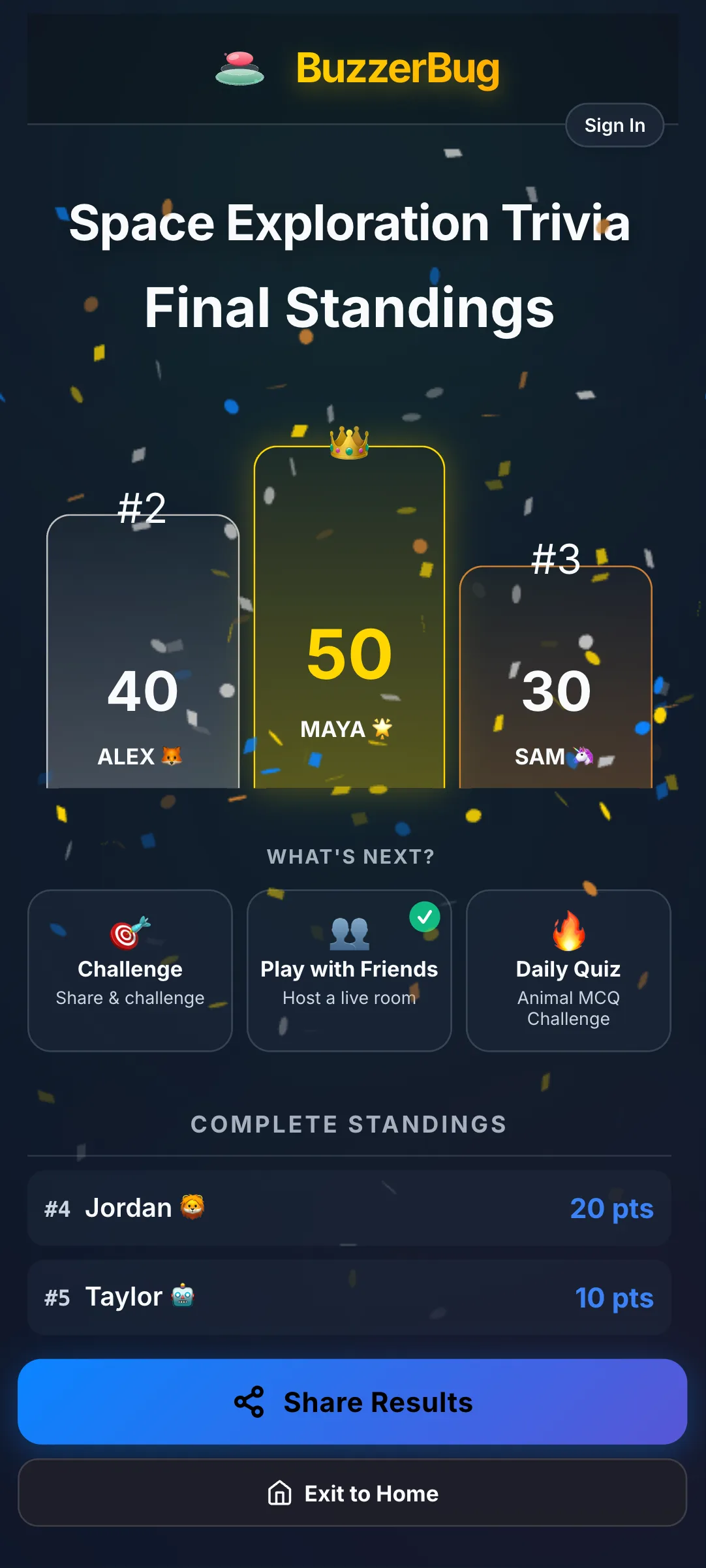
- The rookie player who had never won a trivia game in their life pulling off a miracle guess on the final question to take home the gold podium confetti.
The goal of a game night is not to find the smartest person in the room. The goal of a game night is to create lasting memories.
When a game eliminates awkward friction, takes the hosting burden off your shoulders, and invites everyone to participate regardless of their trivia background, the game steps out of the way. What remains is pure connection, lively debate, and shared joy.
6. Your 3-Minute Friends Night Setup Checklist
Ready to run your own frictionless Friends Night? Here is the complete setup playbook from living room couch to final podium:
| Step | Action | Time Needed | What Happens |
|---|---|---|---|
| 1. Open the TV View | Pull up buzzerbug.com/host on your laptop or Smart TV and click "Open TV Screen". | 30 seconds | The TV displays a full-screen spectator board with a high-contrast room code and QR code. |
| 2. Choose Your Topic | Select an existing catalog quiz or type a custom topic to generate on the fly. | 45 seconds | Choose an Estimation/Slider pack or a blended format with multiple choice. |
| 3. Friends Connect | Tell friends to point their phone cameras at the TV QR code. | 30 seconds | Phones instantly open buzzerbug.com/join with the room code pre-filled. They enter a nickname and join. |
| 4. Enable AI/Bot Host | Toggle automated pacing so the game runs hands-free. | 5 seconds | Questions, timers, buzzer lockouts, and answer reveals advance automatically without a designated host. |
| 5. Play & Celebrate! | Grab your own phone, take your seat on the couch, and tap Start. | 15–20 mins | The room fills with laughter, wild guesses, and podium confetti. |
Ready to Test Your Friends' Best Guesses?
Ditch the stressful question cards, retire the lonely quizmaster role, and discover how electric a game night feels when everyone gets to play.
Launch an instant room, cast it to your living room screen, and see who in your crew has the best instincts:
👉 Start a Live Estimation Quiz on BuzzerBug Now 👉 Try Today's Solo Daily Drop Challenge 👉 Join an Existing Game Room with Your Code
Ready to Play?
Create a free game room in seconds. No download, no account needed for players.
Start a Free Quiz Game