When Is the Best Time to Play a Quiz? How Daily Trivia Builds a Habit of Lifelong Curiosity
Explore why playing a daily quiz is more than trivial entertainment: the cognitive science of active retrieval, how curated daily drops banish decision fatigue, how day-of-the-week categories let you master your favorite subjects, and how simple reminders turn curiosity into a lasting habit.
2026-09-04 · 8 min read · BuzzerBug Editorial Team
The Micro-Rituals That Shape Our Day
Between the morning alarm and switching off the bedside lamp, modern days are punctuated by dozens of transitional micro-moments. We stand at the kitchen counter waiting for coffee to brew. We ride the subway or bus staring at transit advertisements. We sit through three minutes of silence between back-to-back video calls waiting for colleagues to join.
For years, the default human reflex during these small pockets of time has been passive, algorithm-driven consumption: flicking a thumb upward across endless social feeds, reading sensational headlines designed to induce low-grade panic, or mindlessly watching autoplaying short-form videos.
Yet a growing number of thinkers, learners, and trivia lovers are swapping out passive consumption for a completely different micro-ritual: a fast, 3-minute daily quiz.
Far from being a hollow distraction, engaging with structured daily trivia is one of the most cognitively enriching and mood-elevating habits you can introduce into your daily rhythm. But when is the optimal time to play? How do you prevent trivia from falling victim to choice paralysis or feeling like homework? And how does a recurring daily cadence turn fleeting curiosity into a permanent habit of lifelong learning?
Here is the cognitive science, habit architecture, and practical playbook for making trivia a meaningful part of your everyday routine.
1. Why Playing a Quiz Can Be Deeply Meaningful
At first glance, answering trivia questions about 1980s synth-pop, orbital mechanics, or world capitals might seem like simple leisure. Under the hood, however, interactive quizzing stimulates vital neurochemical and psychological mechanisms that benefit both your focus and long-term memory.
Active Recall vs. The Illusion of Competence
Cognitive psychologists have long documented the power of the Testing Effect (formalized by researchers Henry Roediger and Jeffrey Karpicke). When you read an educational article or watch an explainer video, your brain operates in passive recognition mode. Information washes over you, creating what researchers term the illusion of competence—the material feels familiar, so you assume you know it, but the underlying neural connections remain weak.
When you face a quiz question, however, your brain instantly shifts into active retrieval mode. You have to search memory pathways, suppress plausible distractors, and synthesize an answer under a gentle countdown clock. Even when you guess incorrectly, the cognitive effort of attempting retrieval primes the brain to encode the correct answer with dramatically higher retention. Answering five structured questions provides more durable mental exercise than half an hour of passive reading.
The Dopamine of the "Eureka" Moment
Few micro-experiences in daily life are as satisfying as resolving a tip-of-the-tongue state. When a question teases a memory you did not realize you still possessed—and you tap the winning answer right as the timer ticks down—your brain releases a genuine pulse of dopamine. Unlike the synthetic dopamine loops triggered by infinite scrolling, the reward of active recall is rooted in competence, problem-solving, and closure.
Cognitive Palate Cleansing
Modern knowledge work is mentally fatiguing, demanding intense, hyper-focused attention on narrow problems (code, spreadsheets, budgets, emails). A quick quiz acts as a mental palate cleanser. It recruits divergent thinking, sweeping your brain across history, technology, the natural world, and pop culture. That three-minute pivot dislodges mental stagnation, clearing brain fog and allowing you to return to your primary tasks with renewed energy.
2. Banishing Choice Paralysis: Why Daily Quizzes Beat Endless Catalogs
If trivia is so beneficial, why do so many people abandon traditional trivia platforms after a few sessions?
The culprit is almost always decision fatigue—the exact same "Netflix Problem" that leads to browsing streaming libraries for forty minutes without watching a movie.
Imagine opening a traditional quiz app. You are immediately confronted with a daunting directory of 15,000 community-uploaded quiz packs spread across 90 overlapping subcategories:
- Do I want "General Science", "Astrophysics", or "Cell Biology"?
- Is this 1990s Pop Music quiz written for casual listeners or record collectors?
- Who authored these questions? Are they properly fact-checked, or full of typos?
By the time you scroll through five pages of filters, evaluate ratings, and debate what you feel like playing, your window of free time has closed. You exit the app empty-handed, fatigued by the act of choosing.
The Power of the Single "Daily Drop"
This is where BuzzerBug's Daily Quiz changes the game.
Instead of demanding that you act as your own content curator, the Daily Quiz serves one single, impeccably calibrated, 5-question challenge every 24 hours.
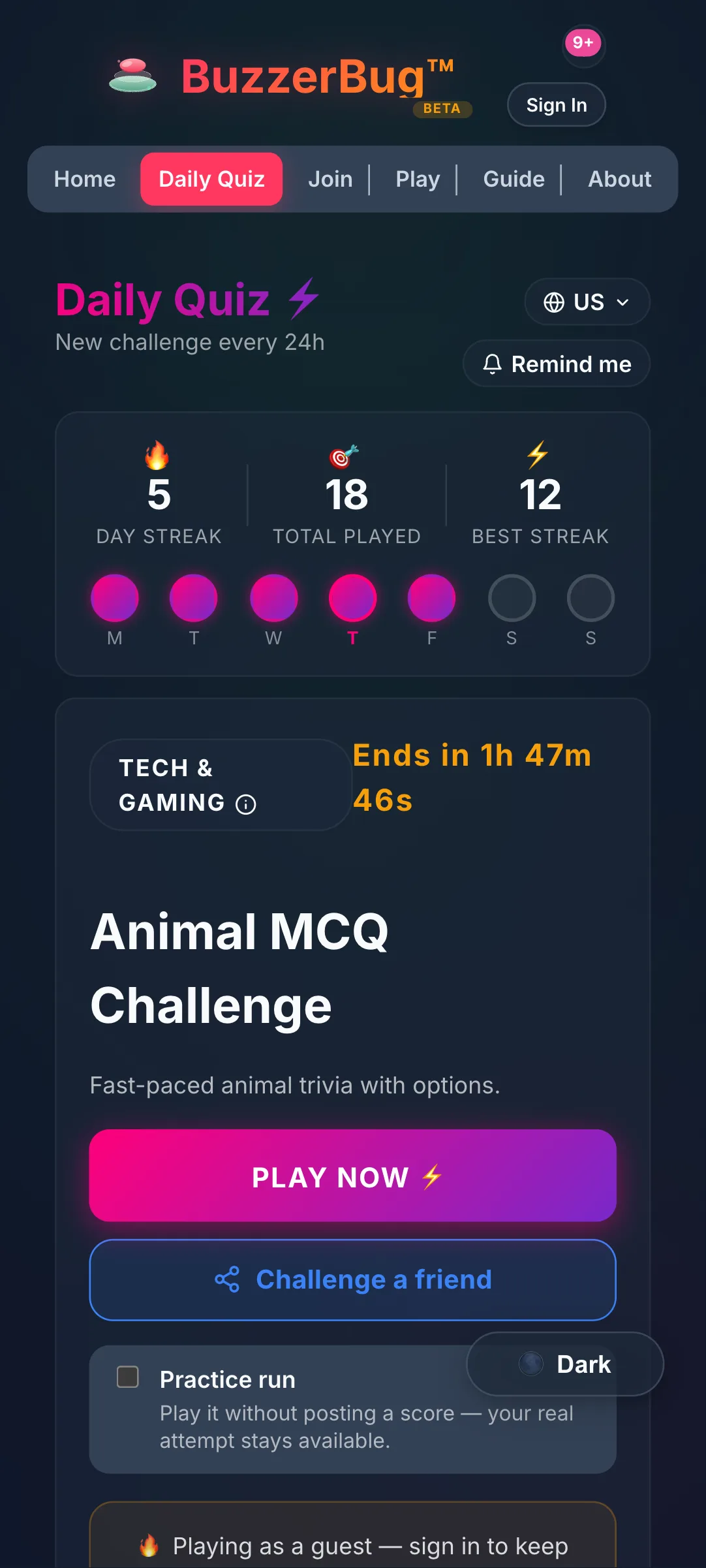
- Zero Friction to Start: You never have to select a category, calibrate a difficulty slider, or configure room settings. You open the tab and tap PLAY NOW ⚡. You are in the game within two seconds.
- Curated & Balanced: Every Daily Drop is carefully vetted for clarity, factual accuracy, and balanced difficulty, ensuring you never face misleading trick questions or esoteric trivia intended for trivia robots.
- A Shared Synchronous Experience: Every player in your region receives the exact same five questions on the exact same calendar day. When you ace a 50-point streak or get caught out on a tricky estimation, your friends and fellow players encountered that exact same challenge.
By eliminating choice paralysis, daily trivia turns a potential chore into an effortless delight.
3. The Weekly Rhythm: How Rotating Daily Categories Let You Play to Your Passions
A common hesitation people have about a single daily quiz is topic mismatch: "What if today's drop is about Renaissance painting and my passion is science fiction?"
BuzzerBug solves this with an intentional Weekly Category Cadence. Rather than throwing random topics into a blender, each day of the week is dedicated to a distinct thematic arena:
| Day of the Week | Featured Theme | What You Will Encounter |
|---|---|---|
| Monday | Cinema & Pop Culture | Iconic movie lines, franchise lore, box-office history, and streaming milestones. |
| Tuesday | Science & Technology | Space exploration, breakthrough discoveries, digital computing, and engineering feats. |
| Wednesday | Sports & World Athletics | Championship records, iconic rivalries, global tournament lore, and underdog triumphs. |
| Thursday | History & World Geography | Ancient civilizations, capital cities, pivotal treaties, and geographical wonders. |
| Friday | Music & Performing Arts | Chart-topping hits, lyrical trivia, legendary artists, and stagecraft classics. |
| Saturday | Nature & The Animal Kingdom | Wildlife adaptations, marine wonders, apex predators, and bizarre biology. |
| Sunday | The Wildcard Arena & Estimations | Drag-slider estimation challenges, numerical extremes, and lateral thinking puzzles. |
Anticipation, Superpowers, and Low-Risk Growth
This structured rotation unlocks two distinct ways to enjoy trivia:
- Play to Your Superpowers: If you are an entertainment buff, Monday is your personal holiday. You know exactly when your wheelhouse arrives, allowing you to bring your A-game, chase a flawless score, and climb the leaderboard.
- Low-Risk Horizon Expansion: What happens on days outside your comfort zone—perhaps Thursday's Geography or Wednesday's Sports? Because the challenge is just five questions, the stakes are delightfully low. You can test your intuition, learn fascinating new facts, and broaden your cultural fluency without the intimidation of a 50-question marathon.
- Community Topic Voting: At the bottom of every Daily Drop, you will find active community voting cards for upcoming topics (such as voting between Classic Sci-Fi, 90s Sitcoms, or Indie Cinema). Players directly shape what topics appear in future drops.
4. Turning Curiosity Into a Daily Ritual: Reminders and the Habit Loop
Meaningful learning rarely happens through sporadic, high-intensity study marathons. It flourishes through lightweight, consistent micro-habits practiced over months and years.
In James Clear's bestselling framework Atomic Habits, lasting routines rely on a four-part feedback loop: **Cue $ ightarrow$ Craving $ ightarrow$ Routine $ ightarrow$ Reward**. Here is how to apply that loop to build a lasting daily trivia habit:
Step 1: Set a Fixed Digital Reminder (The Cue)
Habits require an obvious trigger. Inside the Daily Quiz screen, tap the "Remind me" bell.
Pair this reminder with an anchor habit that is already firmly established in your daily routine:
- "As soon as I pour my first morning coffee, I will play the Daily Quiz."
- "The moment I finish my lunch, I will play the Daily Quiz before checking emails."
Because the quiz requires under three minutes, your brain perceives virtually zero friction to starting.
Step 2: The Momentum of the Streak (The Craving & Routine)
BuzzerBug reinforces your daily consistency with visual streak tracking:
- The Flame Indicator: Watch your active day-streak flame grow from 3 days to 7, 14, and beyond.
- Weekly Progress Tracker: The seven progress dots (M, T, W, T, F, S, S) light up in vibrant color as you complete each drop, providing immediate visual feedback on your week's commitment.
- Practice Mode Available: Worried about risking an active streak when you are tired? You can toggle "Practice run" to explore the questions without posting an official score until you feel primed.
Step 3: Identity & Leveling Up (The Reward)
As you accumulate completed drops and high scores, you build your permanent identity on your Player Profile:
- Unlock Avatars: Earn custom avatar badges—from the roaring 🦁 Lion to the clever 🦊 Fox—complete with active checkmarks and glowing rings.
- Track Lifetime Analytics: Watch your total games, lifetime trivia points, and gold podium medals tally over time.
- Challenge Friends in One Tap: Scored a perfect 50 on today's drop? Tap "Challenge a friend" to generate a direct link. Your friends can play on their own smartphones with zero setup, comparing scores directly on your profile.
Summary Checklist: Your 3-Minute Daily Trivia Ritual
| Step | Action | Practical Benefit |
|---|---|---|
| 1. Pick Your Anchor Window | Choose your morning coffee (8:00 AM) or lunch reset (12:30 PM). | Turns trivia into a frictionless, automatic part of your day. |
| 2. Tap "Remind Me" | Enable notifications on the Daily Quiz screen. | Protects your streak and reminds you when the daily drop resets. |
| 3. Check the Daily Theme | Review today’s category banner (Tech, Pop Culture, History, etc.). | Lets you anticipate your favorite domains and embrace new topics. |
| 4. Play in Under 3 Minutes | Tap PLAY NOW ⚡ and solve five fast-paced questions. | Gives your brain a powerful, dopamine-rich active recall workout. |
| 5. Challenge a Friend | Send your score challenge link to a coworker or partner. | Transforms solo learning into a fun, effortless social bond. |
Ready to replace empty scrolling with a daily boost of mental sharpness? Jump into today's BuzzerBug Daily Quiz, check your streak on your Player Profile, and discover how five questions a day can transform your everyday curiosity.
Ready to Play?
Create a free game room in seconds. No download, no account needed for players.
Start a Free Quiz Game